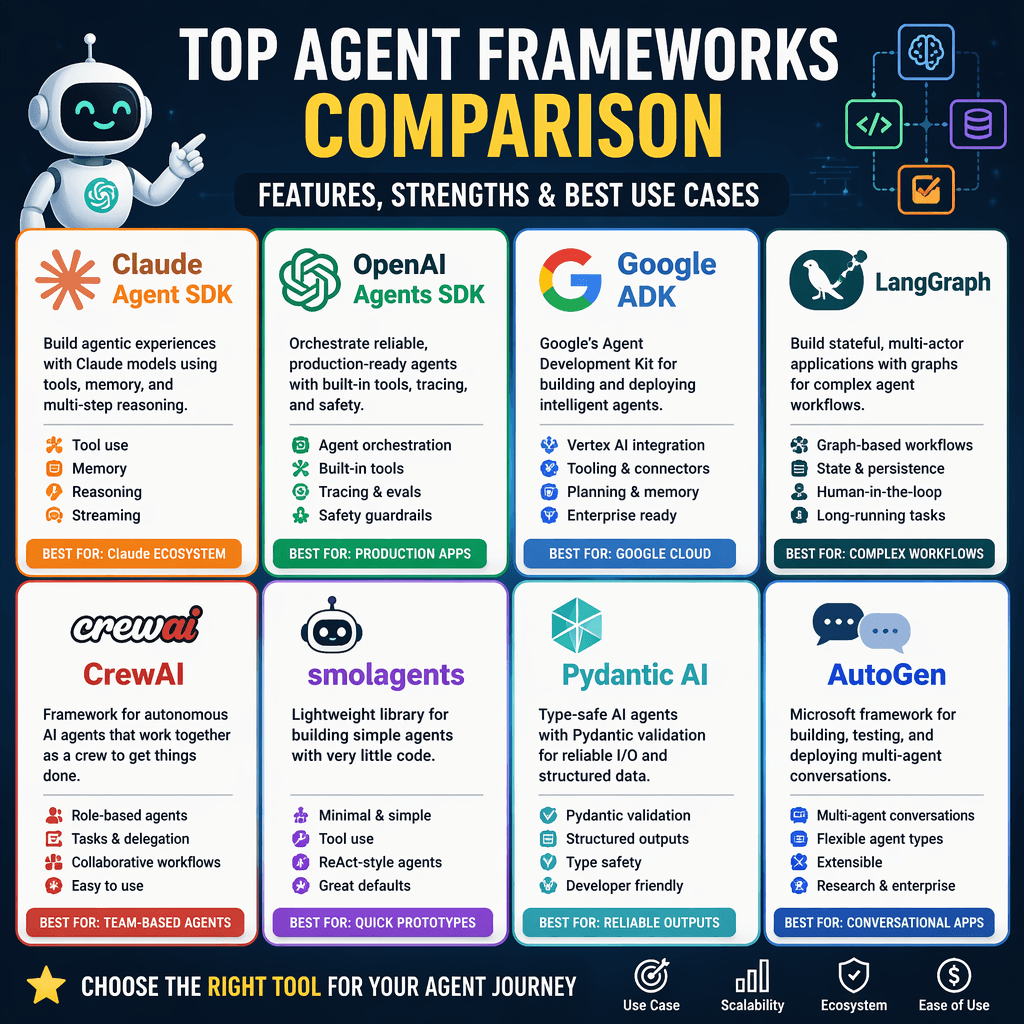
The AI agent ecosystem has matured significantly by 2026, with eight major frameworks and three protocols vying for adoption. Engineers, founders, and operators face critical decisions when choosing tools for building intelligent agents. This article provides a deep dive into the latest SDKs, protocols, and architectural trade-offs to help you make informed decisions.
Framework Overview: Provider-Native vs Independent
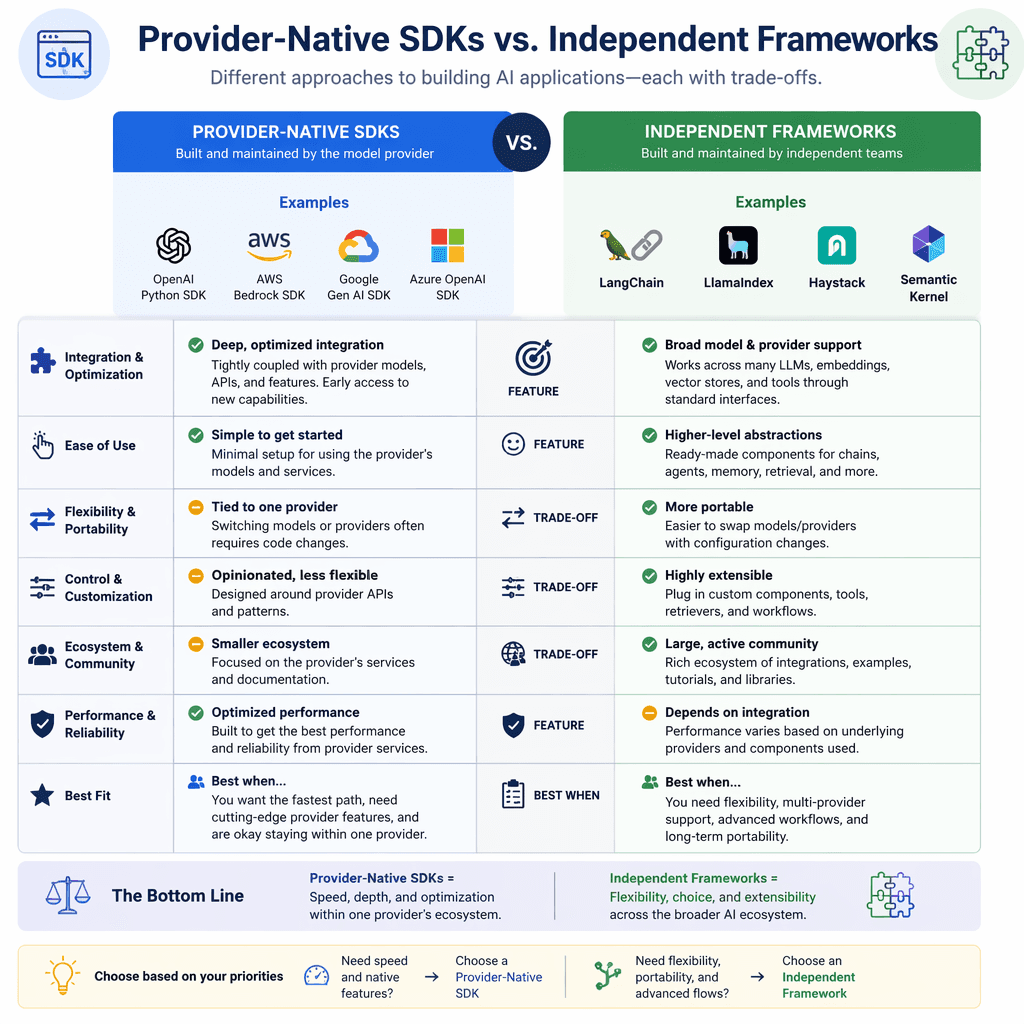
AI agent frameworks fall into two categories: provider-native SDKs optimized for specific model families and independent frameworks designed for cross-provider flexibility. Provider-native SDKs like Claude Agent SDK, OpenAI Agents SDK, and Google ADK offer deep integration with their respective ecosystems. Independent frameworks such as LangGraph, CrewAI, Smolagents, Pydantic AI, and AutoGen prioritize interoperability and customizability. Choosing between these categories depends on your priorities: integration depth versus model flexibility.
Claude Agent SDK: Deep OS-Level Integration
Anthropic's Claude Agent SDK excels in building agents with deep OS-level access. Its hooks system allows lifecycle control, while subagents enable task delegation with isolated contexts. The SDK's MCP integration is unmatched, connecting to over 200 servers with minimal configuration. However, it is locked to Claude models and lacks native A2A/ACP support, limiting cross-vendor communication.
Key Takeaways
- Best for coding agents and research tools requiring OS-level access.
- Deep MCP integration simplifies tool connectivity.
- Limited to Claude models, restricting flexibility.
"Claude Agent SDK is ideal for engineers who need agents to interact directly with the operating system."
OpenAI Agents SDK: Lightweight Multi-Agent Coordination
OpenAI's Agents SDK focuses on simplicity and lightweight multi-agent coordination. Its handoff model allows clean delegation between agents without complex orchestration. Guardrails ensure robust input, output, and tool validation, while built-in tracing simplifies debugging. However, the SDK lacks state persistence and native A2A support, making it less suitable for distributed systems.
Builder note
Use OpenAI Agents SDK for customer service workflows or triage systems where linear handoffs suffice.
Google ADK: Multi-Language Enterprise Support
Google ADK stands out with its support for Python, TypeScript, Java, and Go, making it ideal for enterprise teams. Its native A2A protocol enables cross-vendor agent discovery, while the Agent Designer provides a low-code prototyping environment. However, its heavy reliance on Google Cloud and adapter-based MCP support may deter teams seeking vendor-neutral solutions.
| Signal | Why it matters |
|---|---|
| Multi-language support | Enables enterprise adoption across diverse tech stacks. |
| Native A2A protocol | Facilitates cross-vendor agent communication. |
| Agent Designer | Accelerates prototyping for non-engineering teams. |
LangGraph: Stateful Workflows for Complex Systems
LangGraph, built on LangChain, treats agents as state machines with immutable state and checkpointing. It is ideal for workflows with branching logic, retries, and human approval gates. The framework's persistence layer ensures robustness during server restarts, but its lack of native MCP and A2A support limits interoperability.
- Use LangGraph for workflows requiring state persistence.
- Ideal for systems with human-in-the-loop checkpoints.
- Not suitable for cross-vendor agent ecosystems.
Protocols: ACP, A2A, and MCP
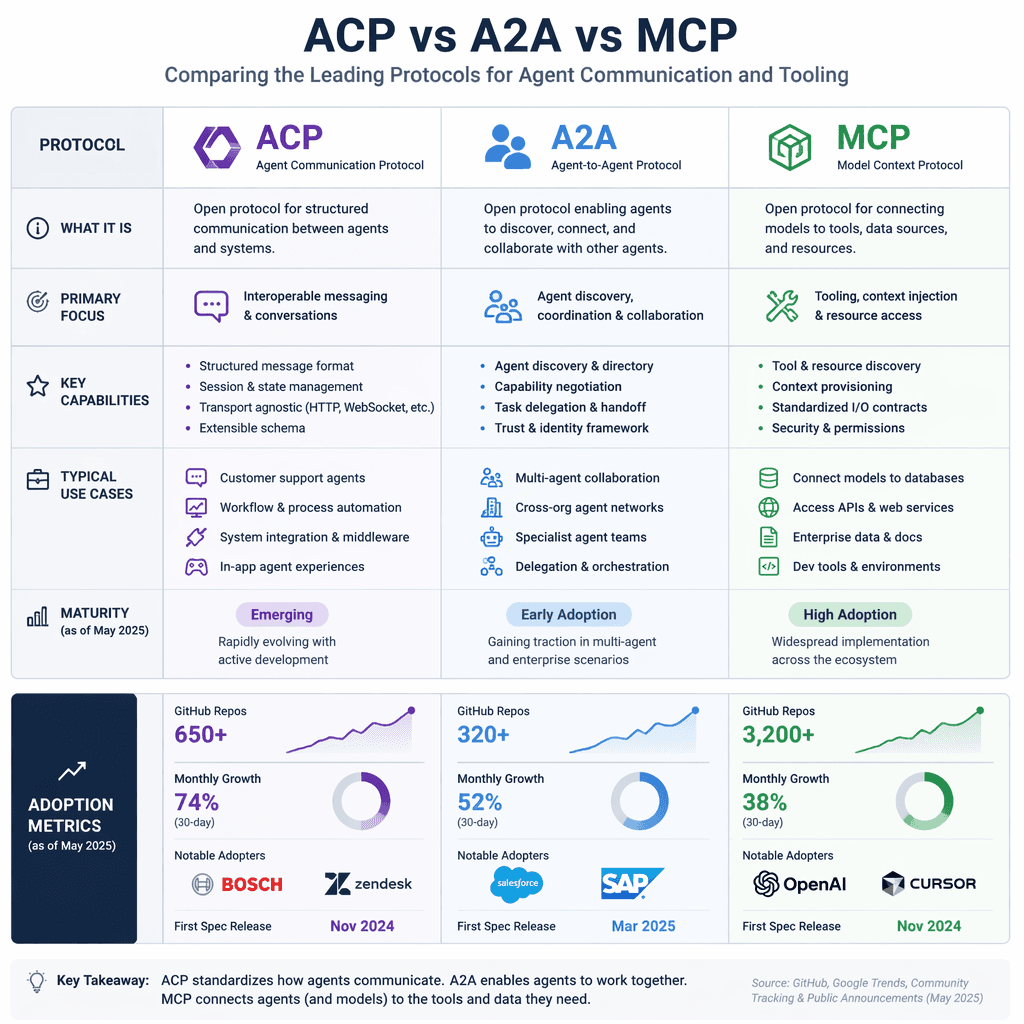
Protocols like ACP, A2A, and MCP are consolidating to standardize agent communication. ACP merged into A2A under the Linux Foundation, simplifying cross-vendor interactions. MCP, with over 200 server implementations, remains the go-to for tool connectivity. Engineers should evaluate protocol compatibility when choosing frameworks to avoid lock-in.
- ACP: Focuses on cross-vendor agent communication.
- A2A: Standardizes agent discovery and capability sharing.
- MCP: Ensures seamless tool integration across frameworks.
Source Card
AI Agent Frameworks in 2026: 8 SDKs, ACP, and the Trade-offs Nobody Talks AboutThis source provides a detailed comparison of AI agent frameworks and protocols, highlighting their strengths, weaknesses, and adoption contexts.
morphllm.com
Choosing the Right Framework
The choice of framework depends on your project requirements. Provider-native SDKs are best for deep integration with specific models, while independent frameworks offer flexibility for multi-provider environments. Protocol compatibility is crucial for cross-vendor communication and tool integration. Consider your team's expertise, deployment environment, and long-term scalability needs.
- https://www.morphllm.com/ai-agent-framework
Builder implications
For teams evaluating Navigating AI Agent Frameworks in 2026: SDKs, Protocols, and Trade-offs, the useful question is not whether the announcement sounds important. The useful question is whether it changes how an agent system is built, tested, operated, or bought. The source from morphllm.com gives builders a concrete signal to inspect: AI Agent Frameworks in 2026: 8 SDKs, ACP, and the Trade-offs Nobody .... That signal should be mapped against the parts of an agent stack that usually become fragile first, including tool contracts, long-running state, evaluation coverage, cost visibility, failure recovery, and the handoff between prototype code and production operations.
Production lens
Treat this as a systems decision, not a headline decision. A builder should ask how the change affects the agent loop, what needs to be measured, which failure modes become easier to catch, and whether the team can explain the behavior to a customer or operator when something goes wrong. If the answer is vague, the technology may still be useful, but it is not yet a production advantage.
Adoption checklist
- Identify the workflow where AI agent frameworks, SDK comparison, protocols, engineering trade-offs already creates measurable pain, such as slow triage, brittle handoffs, unclear ownership, or poor observability.
- Write down the current baseline before changing the stack: latency, cost per run, recovery rate, review time, and the percentage of tasks that need human correction.
- Prototype against a real internal workflow instead of a demo task. The workflow should include imperfect inputs, missing context, tool failures, and at least one approval step.
- Add traces, event logs, and evaluation checkpoints before expanding usage. A new framework or model is hard to judge when the team cannot see where the agent made its decision.
- Keep rollback boring. The first version should let an operator pause automation, inspect the last decision, and return control to a human without losing state.
- Review the source again after testing. The source-backed claim should line up with observed behavior in your own environment, not just with launch copy or release notes.
| Area | Question | Practical test |
|---|---|---|
| Reliability | Does the agent fail in a way operators can understand? | Run the same task with missing data, stale data, and a tool timeout. |
| Observability | Can the team reconstruct why a decision happened? | Inspect traces for inputs, tool calls, model outputs, approvals, and final state. |
| Cost | Does value scale faster than usage cost? | Compare cost per successful task against the old human or scripted workflow. |
| Governance | Can sensitive actions be reviewed or blocked? | Require approval on high-impact actions and log who approved the step. |
What to watch next
The next signal to watch is whether builders start publishing implementation notes, migration stories, benchmarks, or reliability reports around this source. That secondary evidence matters because agent infrastructure often looks clean at release time and only shows its real shape once teams connect it to messy business workflows. Strong follow-on evidence would include reproducible examples, clear limits, documented failure recovery, and customer stories that describe what changed in the operating model.
Key Takeaways
- Do not treat a release as automatically production-ready because it comes from a strong source.
- Use the source as a reason to test a specific workflow, not as a reason to rewrite the entire stack.
- The best early signal is not novelty. It is whether the system becomes easier to observe, recover, and improve.