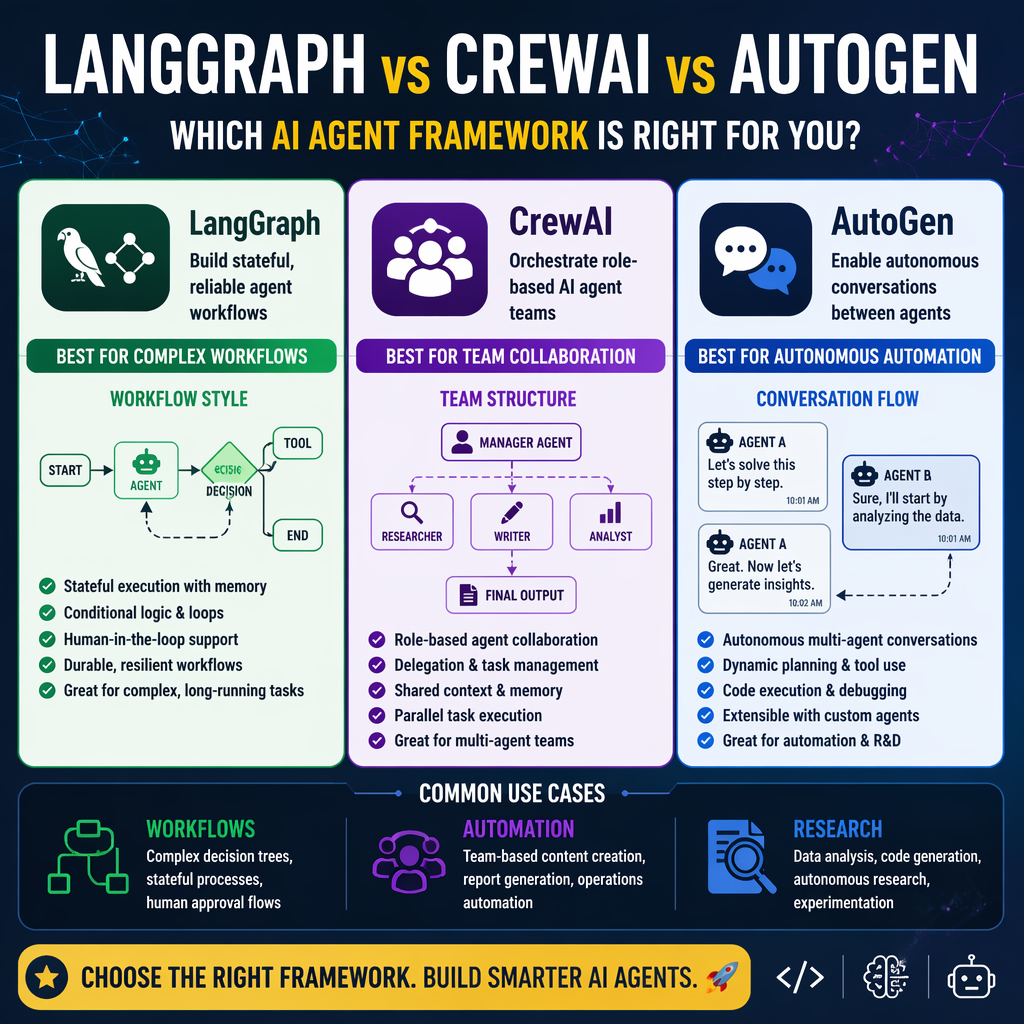
By 2026, AI agent frameworks have become essential tools for developers building autonomous systems that plan, reason, and execute workflows with minimal human intervention. With enterprise adoption accelerating, choosing the right framework can significantly impact your project’s success. This article compares LangGraph, CrewAI, and AutoGen, diving into their strengths, tradeoffs, and practical use cases.
What Are AI Agent Frameworks?
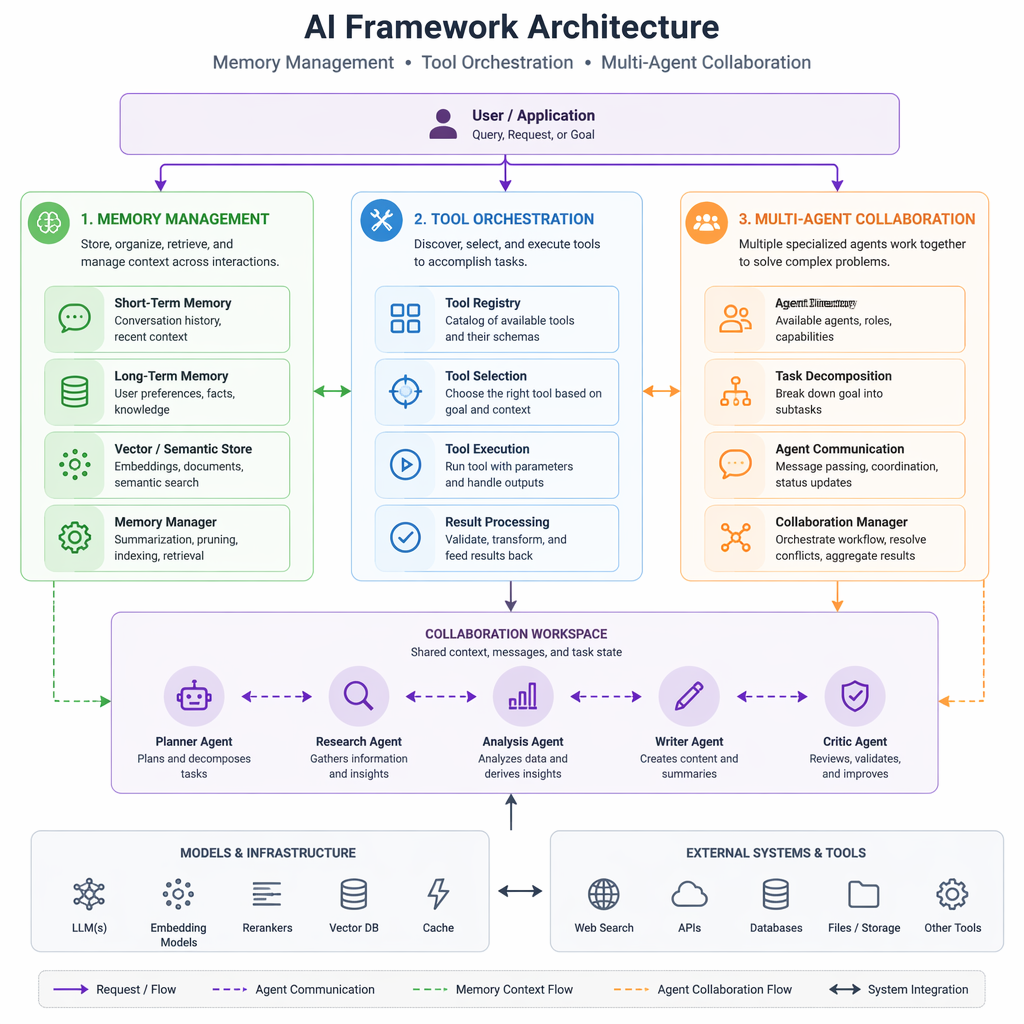
AI agent frameworks are toolkits for creating autonomous systems that go beyond simple prompt-response models. These frameworks enable agents to plan multi-step tasks, use external tools, maintain memory, and collaborate with other agents. They handle infrastructure like memory management, tool orchestration, and error handling, allowing developers to focus on functionality.
LangGraph: Precision for Complex Applications
LangGraph, part of the LangChain ecosystem, uses a graph-based approach to model workflows. Nodes represent functions or agents, while edges define transitions. This structure provides fine-grained control over execution flow, making it ideal for applications requiring detailed state management and auditability.
Key Takeaways
- LangGraph excels in stateful workflows and human-in-the-loop capabilities.
- It integrates deeply with LangChain’s ecosystem, offering over 100 tools.
- Best suited for complex applications like customer support bots or data pipelines.
"LangGraph’s graph-based design is unmatched for applications requiring precise control over execution flow."
CrewAI: Simplifying Business Automation
CrewAI models agents as a team of specialists, each with a defined role and task. This role-based design mirrors real-world teams, making it intuitive for business automation workflows. It offers built-in task delegation and collaboration, reducing boilerplate code and speeding up development.
Builder note
CrewAI’s simplicity makes it a strong choice for founders and operators looking to automate business processes without deep technical expertise.
AutoGen: Flexibility for Research and Experimentation
AutoGen, backed by Microsoft Research, focuses on multi-agent conversational systems. It allows developers to define custom agent types, conversation patterns, and termination conditions. While its flexibility is a strength, it requires more setup and infrastructure compared to LangGraph and CrewAI.
Source Card
AI Agent Frameworks for Developers: LangChain vs CrewAI vs AutoGen in ...This source provides a detailed comparison of leading AI agent frameworks, including benchmarks and practical insights for developers.
fungies.io
| Signal | Why it matters |
|---|---|
| LangGraph excels in stateful workflows. | Ideal for applications requiring detailed control and auditability. |
| CrewAI simplifies business automation. | Best for workflows that map to real-world team structures. |
| AutoGen offers flexibility for research. | Useful for experimental systems and custom agent behaviors. |
Performance Benchmarks
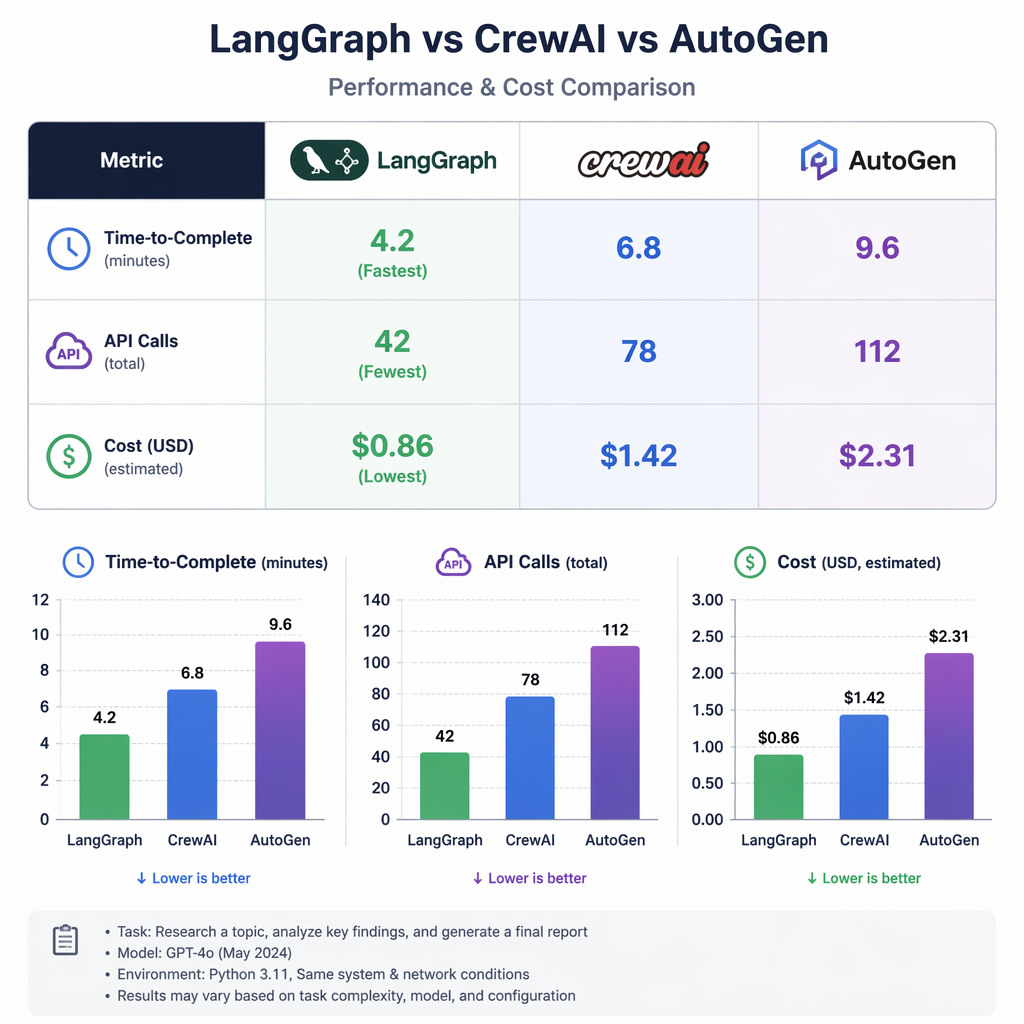
To compare frameworks, identical tasks were run across LangGraph, CrewAI, and AutoGen. The task involved researching a topic, analyzing sources, and writing a summary. CrewAI was fastest and cheapest, while LangGraph had the highest success rate due to robust error handling. AutoGen provided flexibility but required more resources.
| Metric | LangGraph | CrewAI | AutoGen |
|---|---|---|---|
| Time to Complete | 45 seconds | 38 seconds | 52 seconds |
| API Calls | 12 | 8 | 15 |
| Cost (Claude 3.5 Sonnet) | $0.042 | $0.031 | $0.058 |
| Success Rate (100 runs) | 94% | 91% | 87% |
| Lines of Code Required | 78 | 45 | 92 |
Implementation Guidance
- Define your agent’s purpose: Clarify goals, tools, memory needs, and constraints.
- Choose the right framework: LangGraph for control, CrewAI for simplicity, AutoGen for flexibility.
- Set up memory: Use vector databases like Pinecone or Weaviate for long-term memory.
- Connect tools: Leverage pre-built tools in LangGraph or define custom tools in AutoGen.
- Deploy and monitor: Use managed services like LangGraph Cloud or set up DIY infrastructure for AutoGen.
- LangGraph is ideal for applications requiring detailed state management.
- CrewAI simplifies workflows for business automation.
- AutoGen excels in research and experimental setups.
Key Takeaways
LangGraph, CrewAI, and AutoGen each serve distinct use cases. LangGraph is best for complex, stateful applications. CrewAI simplifies business automation with its role-based design. AutoGen offers flexibility for research but requires more setup. Choose based on your project’s needs and constraints.
- https://fungies.io/ai-agent-frameworks-langchain-crewai-autogen-2026
Builder implications
For teams evaluating Choosing the Right AI Agent Framework: LangGraph vs CrewAI vs AutoGen, the useful question is not whether the announcement sounds important. The useful question is whether it changes how an agent system is built, tested, operated, or bought. The source from fungies.io gives builders a concrete signal to inspect: AI Agent Frameworks for Developers: LangChain vs CrewAI vs AutoGen in .... That signal should be mapped against the parts of an agent stack that usually become fragile first, including tool contracts, long-running state, evaluation coverage, cost visibility, failure recovery, and the handoff between prototype code and production operations.
Production lens
Treat this as a systems decision, not a headline decision. A builder should ask how the change affects the agent loop, what needs to be measured, which failure modes become easier to catch, and whether the team can explain the behavior to a customer or operator when something goes wrong. If the answer is vague, the technology may still be useful, but it is not yet a production advantage.
Adoption checklist
- Identify the workflow where AI agent frameworks, LangGraph, CrewAI, AutoGen already creates measurable pain, such as slow triage, brittle handoffs, unclear ownership, or poor observability.
- Write down the current baseline before changing the stack: latency, cost per run, recovery rate, review time, and the percentage of tasks that need human correction.
- Prototype against a real internal workflow instead of a demo task. The workflow should include imperfect inputs, missing context, tool failures, and at least one approval step.
- Add traces, event logs, and evaluation checkpoints before expanding usage. A new framework or model is hard to judge when the team cannot see where the agent made its decision.
- Keep rollback boring. The first version should let an operator pause automation, inspect the last decision, and return control to a human without losing state.
- Review the source again after testing. The source-backed claim should line up with observed behavior in your own environment, not just with launch copy or release notes.
| Area | Question | Practical test |
|---|---|---|
| Reliability | Does the agent fail in a way operators can understand? | Run the same task with missing data, stale data, and a tool timeout. |
| Observability | Can the team reconstruct why a decision happened? | Inspect traces for inputs, tool calls, model outputs, approvals, and final state. |
| Cost | Does value scale faster than usage cost? | Compare cost per successful task against the old human or scripted workflow. |
| Governance | Can sensitive actions be reviewed or blocked? | Require approval on high-impact actions and log who approved the step. |
What to watch next
The next signal to watch is whether builders start publishing implementation notes, migration stories, benchmarks, or reliability reports around this source. That secondary evidence matters because agent infrastructure often looks clean at release time and only shows its real shape once teams connect it to messy business workflows. Strong follow-on evidence would include reproducible examples, clear limits, documented failure recovery, and customer stories that describe what changed in the operating model.
Key Takeaways
- Do not treat a release as automatically production-ready because it comes from a strong source.
- Use the source as a reason to test a specific workflow, not as a reason to rewrite the entire stack.
- The best early signal is not novelty. It is whether the system becomes easier to observe, recover, and improve.